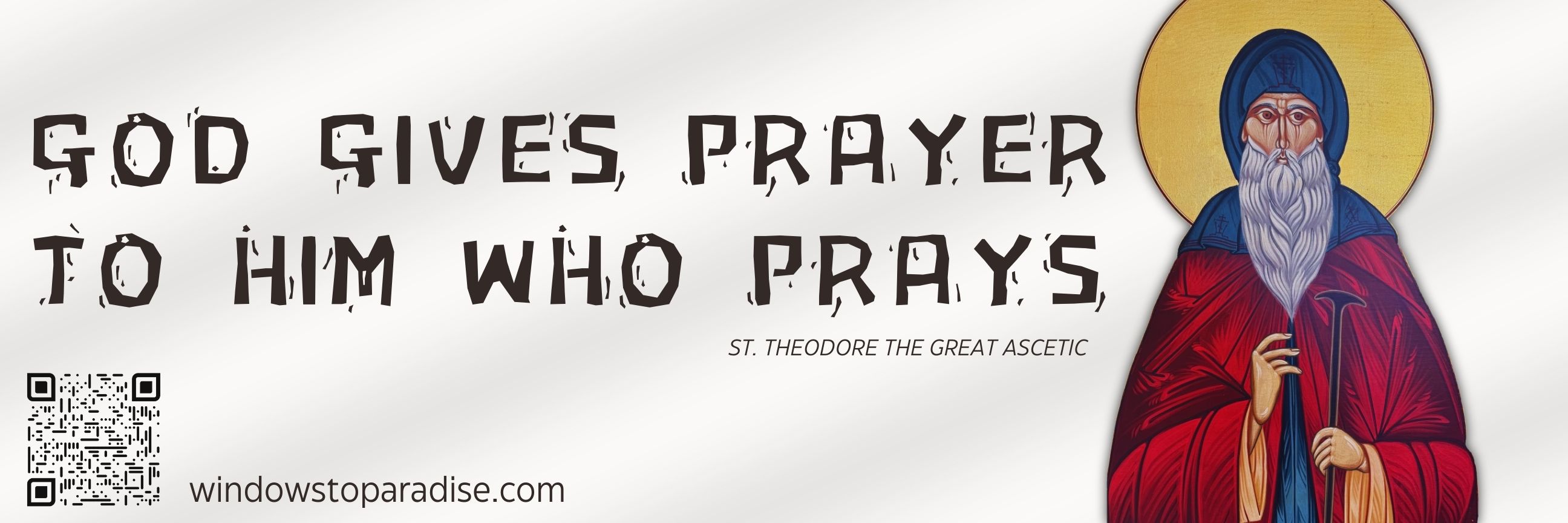
Monk · Theologian · Man of Prayer
"God gives prayer to him who prays."
— From the Ladder of Divine Ascent, inspired tradition
St. Theodore the Great Ascetic was a ninth-century monk and theologian known for his remarkable depth of prayer and his defense of icon veneration during the Second Iconoclasm. Born in Constantinople around 759 AD, he entered monastic life at a young age and became one of the most influential spiritual writers of the Byzantine Church.
Theodore's spirituality was rooted in a simple and profound conviction: that prayer is not a human achievement, but a divine gift. "God gives prayer to him who prays," he wrote — meaning that the very desire to pray, the ability to persist in prayer, is itself given to us by God. The more we pray, the more capacity for prayer we are given. It is a relationship, not a technique.
"God gives prayer to him who prays."
This teaching was not abstract for Theodore. He lived it out through years of monastic struggle, through the hardships of exile, and through the suffering of persecution under iconoclast emperors who sought to suppress the veneration of sacred images. He was beaten and imprisoned multiple times for his faith.
Theodore's defense of icons was not merely political — it was theological. He understood that the Incarnation itself vindicated the use of images. If God became man in Jesus Christ, then the human face of Christ could be depicted. To deny this, he argued, was to deny the reality of the Incarnation.
This conviction connects beautifully to the mission of Windows To Paradise: that the faces of the saints — depicted in the ancient iconographic tradition — are windows through which divine grace still flows. The saints are not gone. They are present, interceding, alive in God.
Theodore died around 826 AD, venerated as a confessor and saint by both Catholic and Orthodox communities. His writings continue to be studied in monasteries across the world, and his insight on prayer remains as fresh and urgent as it was twelve centuries ago.
St. John Chrysostom
"No one can harm the man who does himself no wrong."
Coming Soon →
St. Thérèse of Lisieux
"Miss no single opportunity of making some small sacrifice."
Coming Soon →
St. Seraphim of Sarov
"Acquire a peaceful spirit, and thousands around you will be saved."
Coming Soon →